In our fast-paced, digitally saturated world, our eyes are constantly feeding on a stream of fleeting images—advertisements, social media feeds, and news headlines—that often leave us feeling distracted and fragmented. In this visual noise, the ancient Tibetan art of the Thangka offers a profound antidote. More than a mere painting, a Thangka is a sacred map for the soul, a detailed blueprint of enlightenment designed not just to be seen, but to be entered. For the modern seeker, it becomes a powerful tool to re-orient a scattered mind toward clarity, compassion, and wisdom.
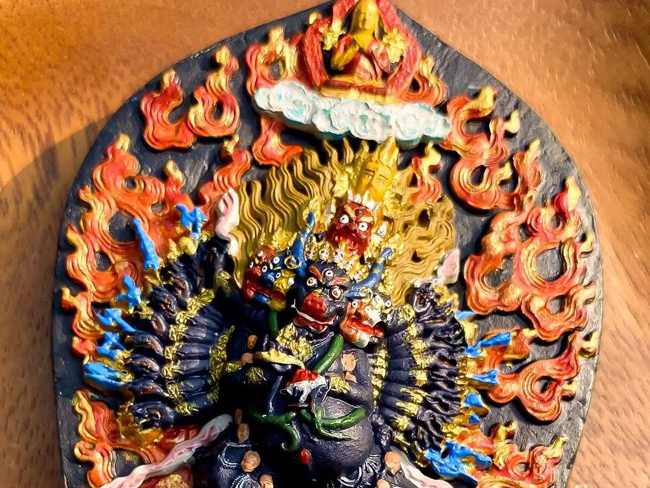
At first glance, a Thangka can be overwhelming. Its vibrant colors and intricate details depict Buddhas, deities, and celestial realms in a complex, symbolic language. Yet, this is not art for art’s sake. Every element, from the posture of a hand to the color of a robe, is governed by strict iconometric rules outlined in ancient texts like the "Measurements of the Body." This disciplined structure ensures that the image is not a product of personal whim, but a precise conduit for spiritual truths. The Thangka is, in essence, a visualized scripture.
The true magic of the Thangka, however, lies not in its static beauty but in its dynamic function: it is a support for meditation. A practitioner does not simply admire a Thangka from a distance; they engage with it. Seated before the painting, they systematically absorb its details. They visualize themselves entering the mandala, identifying with the compassionate and serene form of the central deity, such as the boundless compassion of Avalokiteshvara or the profound wisdom of Manjushri. This process, known as deity yoga, is a profound act of psychological re-identification. It is not about worshipping an external god, but about recognizing and cultivating those same enlightened qualities within oneself.
So, how can this ancient visual technology serve us in our contemporary lives? Most of us will not have the time or training for such elaborate visualization. Yet, the core principle is immediately accessible: we become what we behold.
Consider what your mind "beholds" throughout a typical day. The anxiety-inducing news cycle, the curated perfection on Instagram, the relentless pressure to achieve—these images shape our inner landscape, fostering comparison, fear, and dissatisfaction. The Thangka presents a conscious alternative. By spending even a few quiet moments gazing at a image of a Thangka, we are, in effect, cleansing our visual palate. We are feeding our subconscious a diet of harmony, balance, and enlightened presence.
A Practical Invitation:
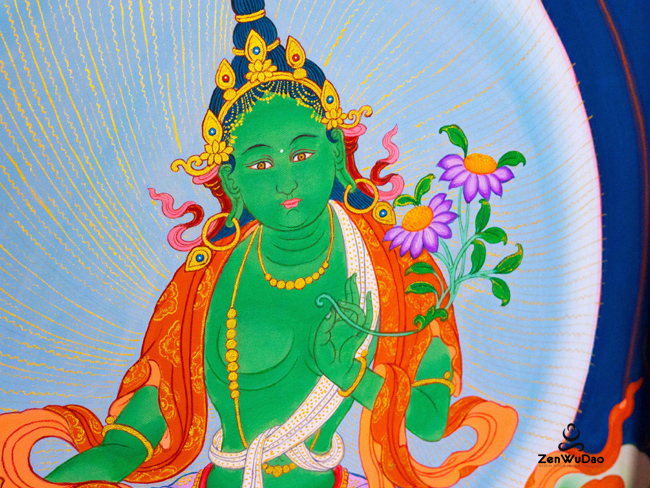
You can engage with a Thangka without any special knowledge. Find a digital image of a peaceful Buddha or a Green Tara, the embodiment of compassionate action.
1. Sacred Pause: Begin by simply letting your gaze rest softly on the image. Take a few deep breaths, allowing the colors and forms to wash over you.
2. Contemplate a Quality: Notice the serene expression, the posture of meditation. What quality does this figure embody? Is it unwavering peace? Fierce protection? All-embracing compassion? Silently name this quality.
3. Internalize the Feeling: As you breathe in, imagine drawing that very quality into the core of your being. As you breathe out, imagine any stress or clutter dissolving away. You are not looking atpeace; you are inviting the feeling of peace within.
4. Carry the Anchor: Later in your day, when faced with stress, recall the image in your mind's eye. Let it be a visual anchor that returns you to a state of centered awareness.
The Thangka ultimately teaches that our reality is shaped by our perception. It challenges the modern notion of a fixed, isolated self, proposing instead that our mind is a luminous, malleable space capable of profound transformation. By consciously choosing the images and qualities we internalize, we move from being passive consumers of visual stimuli to active architects of our inner world.
In the silent dialogue between the viewer and the viewed, the Thangka acts as a sacred mirror. It does not show you who you are in this fleeting moment, but who you have the potential to become: a being of boundless clarity, compassion, and peace. The journey it maps is not to a distant heaven, but inward, to the vast and luminous landscape of your own true nature.