To the outside observer, Tibetan Buddhism can appear as a colorful but complex web of rituals, deities, and mantras. However, beneath this vibrant surface lies a rigorous and sophisticated philosophical architecture. For Tibetans, Buddhism is not merely a faith but a logical and experiential science of the mind, offering a profound path to understanding the nature of reality. This article delves into the core philosophical views and the structured path that defines this tradition.
The Heart of Wisdom: The Middle Way and Emptiness
The philosophical bedrock of Tibetan Buddhism is Madhyamaka, or the "Middle Way" philosophy, founded by the Indian master Nagarjuna . Madhyamaka seeks a middle path between the extremes of eternalism (the belief in a permanent, unchanging self or entity) and nihilism (the belief that nothing matters because everything ceases to exist). Its central thesis is the doctrine of "Shunyata" (Emptiness).
It is crucial to understand that Emptiness does not mean nothingness. Instead, it signifies that all phenomena—from tables and mountains to our very sense of "self"—are empty of inherent, independent existence. Nothing exists in isolation; everything arises dependent on a vast network of causes and conditions. This is the principle of "Pratityasamutpada" (Dependent Origination). A cup, for example, is "empty" of a permanent "cup-ness." Its existence depends on the glassblower, the sand, the fire, the concept "cup," and the perceiver who labels it as such. By analyzing all phenomena in this way, the practitioner deconstructs fixed, solid perceptions of the world, which are the root of attachment, aversion, and ignorance. As one text states, the ultimate goal is to understand that all things are "'rangtong' (empty of self-nature)" .
Diverse Paths to the Same Truth: Philosophical Debates within Tibetan Buddhism
While all Tibetan schools accept Madhyamaka as the highest view, they have different interpretive strains and emphases. A significant historical debate was between the "Rangtong" (self-empty) and "Shentong" (other-empty) views.
-
The Rangtong view, championed by the Gelug school, asserts that all phenomena without exception are empty of their own inherent nature. This is a strict application of Nagarjuna's philosophy.
-
The Shentong view, associated historically with the Jonang school and influential in the Kagyu and Nyingma traditions, posits that while relative phenomena are empty, the ultimate reality (Buddha Nature, or the mind's innate clarity) is not empty of its own inherent, positive qualities. It is only "empty" of the adventitious defilements (passions, ignorance) that obscure it.
This nuanced debate highlights the intellectual vitality within Tibetan Buddhism, showing that it encourages deep inquiry rather than blind belief.
The Structured Path: From Basic Morality to Highest Enlightenment
Tibetan Buddhism is renowned for its "step-by-step" paths (Lamrim) that systematically guide a practitioner from basic spirituality to the highest realizations. A foundational text for this approach is "The Stages of the Path" (Lamrim), which itself is based on Atisha's "Lamp for the Path to Enlightenment." This structure organizes the entire Buddhist path into three levels of motivation, making it accessible to everyone :
-
The Scope of the Lesser Vehicle: Focused on individuals who seek to avoid lower rebirths and attain a better future life or personal liberation (nirvana). The practice here is grounded in ethics, understanding karma (the law of cause and effect), and contemplating the fragility of human life.
-
The Scope of the Medium Vehicle: This level deepens the understanding of renunciation and is traditionally aligned with the goal of the Arhat, who seeks personal liberation from the cycle of suffering (samsara).
-
The Scope of the Great Vehicle (Mahayana): This is the heart of the path. The practitioner develops Bodhichitta—the profound and compassionate aspiration to attain full enlightenment for the benefit of all sentient beings. The practices here are the intensive cultivation of the Six Perfections and the wisdom of emptiness.
Integrating the View: Philosophy as a Lived Experience
In Tibetan Buddhism, philosophy is never an end in itself. It is a tool to be integrated through meditation. The analytical meditation on emptiness, for instance, is designed to deconstruct our ingrained wrong views. This is then balanced with "calm-abiding" (shamatha) meditation to stabilize the mind. The ultimate goal is "yuganaddha," the union of serenity and insight, where one can rest the mind single-pointedly on the nature of reality while simultaneously perceiving its empty, luminous quality.
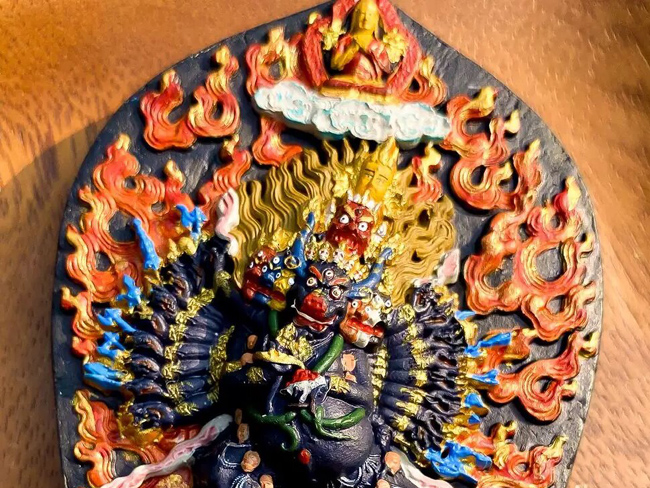
This sophisticated philosophical system, which moves from intellectual understanding to direct experiential realization, provides the foundational worldview upon which all Tibetan Buddhist art and advanced practice is built. The intricate thangkas and the profound deity yogas are not separate from this philosophy; they are its visual and practical expressions.