Introduction: From Abstract Concept to Practical Principles
In our first article, we introduced the Dao as the ultimate, flowing source of all things. But how do we translate this abstract concept into a practical guide for living? Daoist philosophy provides us with a set of powerful, interlocking principles that act as a map for navigating life in harmony with the Dao. The two most essential of these are the dynamic balance of Yin and Yang and the paradoxical practice of Wu Wei.
Yin and Yang: The Dynamic Duality
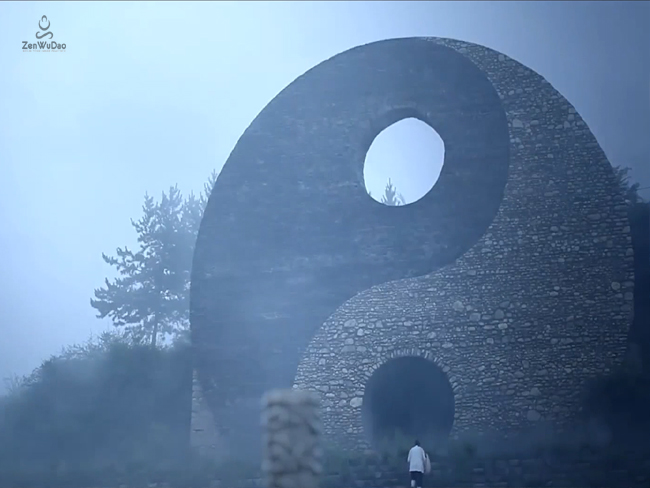
Most people have seen the famous Taijitu symbol—the circle divided by a sinuous line into black and white teardrops, each containing a dot of the opposite color. This is not a symbol of static opposition, but of dynamic, relational, and complementary balance.
-
Yin is the dark, receptive, feminine, cool, yielding, and intuitive aspect. It is associated with the moon, valleys, and water.
-
Yang is the light, active, masculine, warm, assertive, and rational aspect. It is associated with the sun, mountains, and fire.
The profound wisdom of this symbol lies in several key insights:
-
Interdependence: Yin and Yang cannot exist without each other. There is no "light" without "dark" to define it. There is no "activity" without "rest" to make it possible. They are co-creators of reality.
-
Constant Flux: The curved line shows that Yin and Yang are in a constant state of flow and transformation. Day gradually becomes night (Yang into Yin), which in turn becomes day again (Yin into Yang).
-
Seed of the Opposite: The small dots within each half signify that at the peak of one force, the seed of the other is already present. At the height of summer (Yang), the seed of winter (Yin) is born, and vice-versa. This teaches us that no situation is permanent.
Application to Modern Life: The stress of a high-powered job (Yang) can only be sustained with sufficient rest, meditation, and quiet time (Yin). A creative breakthrough (often a Yin, intuitive process) often follows a period of intense, focused study (Yang). Daoism teaches us to recognize these rhythms in our own lives and not to cling excessively to one pole. Seeking only Yang (action, achievement) leads to burnout. Seeking only Yin (passivity, withdrawal) leads to stagnation. The secret is to dance gracefully between them.
Wu Wei: The Art of Effortless Action
Perhaps the most misunderstood Daoist concept is Wu Wei. It is literally translated as "non-action" or "inaction," which sounds like laziness or passivity. This is a profound misreading.
Wu Wei is "actionless action" or "effortless doing." It is the practice of taking action that is perfectly in accord with the natural flow of the Dao. It is the behavior of the sage who has so completely aligned themselves with the way of nature that their actions are spontaneously correct, effective, and without wasteful friction.
Think of skilled performers who exhibit Wu Wei:
-
A veteran jazz musician who doesn't think about the notes but simply lets the music flow through them.
-
An elite athlete "in the zone," whose movements are fluid, instinctive, and perfectly responsive to the game.
-
A master carpenter who works with the grain of the wood, not against it.
In all these cases, there is tremendous action and achievement, but it feels effortless because it is not forced. It arises from a place of deep connection and understanding, not from ego-driven struggle.
Wu Wei is not about doing nothing; it's about not forcing anything. It's the difference between trying to push a river (exhausting and futile) and steering a boat by using the river's current (intelligent and effective).
Application to Modern Life: Are you trying to make a conversation happen, resulting in awkwardness? Or are you allowing it to flow naturally (Wu Wei)? Are you forcing a business solution that fights against market trends, or are you adapting your approach to move with them? Wu Wei is the principle behind "working smarter, not harder." It encourages us to pause, observe the natural patterns at play, and then act in a way that is timely, appropriate, and yields the maximum result with minimum effort.
Together, Yin-Yang and Wu Wei provide a framework for living that values adaptability, awareness, and natural efficiency over rigid planning and forceful striving. In our next article, we will explore the foundational texts where these ideas were first penned: the Daodejing and the Zhuangzi.